Tris(hydroxymethyl)aminomethane (CAS 77-86-1) – Research Grade
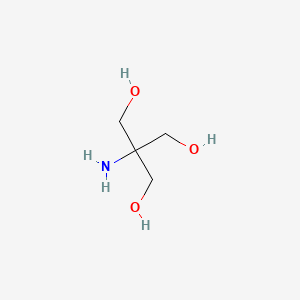
Tris is a primary amino compound that is tert-butylamine in which one hydrogen attached to each methyl group is replaced by a hydroxy group. A compound widely used as a biological buffer substance in the pH range 7--9; pKa = 8.3 at 20 ℃; pKa = 7.82 at 37 ℃. It has a role as a buffer. It is a triol and a primary amino compound. It is a conjugate base of a member of Htris.
Research Context
Tris(hydroxymethyl)aminomethane, commonly referred to as THAM or Tris, is widely utilized in biochemical and molecular biology research due to its role as a buffering agent. Its pH-stabilizing properties make it an ideal choice for maintaining physiological pH levels during various laboratory procedures, including enzyme reactions and electrophoresis. This compound supports optimal conditions for biological activity, allowing researchers to ensure consistency and reliability in experimental outcomes.
Research Applications
THAM is extensively applied in various fields, including biochemistry, pharmaceuticals, and cellular biology. It is commonly used in the preparation of buffers for protein purification and enzyme assays, where precise pH control is critical. Additionally, THAM is employed in cell culture media, providing stable pH environments conducive to optimal cell growth and function. Its non-toxic nature makes it suitable for diverse biological applications, contributing to its popularity in laboratory settings.
Mechanism of Action
The buffering capacity of Tris arises from its ability to resist changes in pH, primarily due to its protonation and deprotonation dynamics. At physiological pH, THAM exists predominantly in a form that can effectively neutralize acids and bases, thereby maintaining a stable environment for various biochemical reactions. This characteristic is essential in enzymatic studies, where fluctuations in pH can significantly impact enzyme activity and stability.
Solubility and Storage Advice
Tris is soluble in water, making it easy to prepare buffer solutions at various concentrations. It is recommended to store THAM in a cool, dry place, away from direct sunlight, to ensure its stability over time. Solutions should be prepared fresh when possible, or stored at 4°C for short-term use. Avoid freezing, as this may affect the buffer's effectiveness.
Future Research Directions
Future research involving Tris(hydroxymethyl)aminomethane could explore its potential applications in novel biotechnological processes, including gene editing and synthetic biology. Investigations into optimizing its buffering capacity for extreme pH environments may also yield valuable insights, enhancing its utility in various scientific fields. As researchers continue to uncover new applications, THAM remains a vital component in the toolkit of modern biochemical research.
Need this compound? Check current availability and pricing.
| CAS Number | 77-86-1 |
|---|---|
| Formula | C4H11NO3 |
| Mol. Weight | 121.14 g/mol |
| IUPAC Name | 2-amino-2-(hydroxymethyl)propane-1,3-diol |
| Grade | Research Grade |
Technical Support & Logistics
Storage & Handling: Tris is strictly allocated for laboratory research use (RUO). Shipped in anti-static packaging.