Sodium Chloride (CAS 7647-14-5) – Research Grade
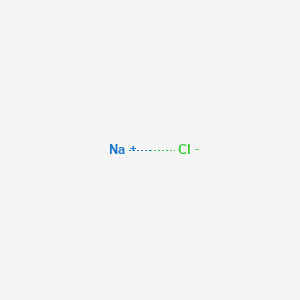
Sodium chloride is an inorganic chloride salt having sodium(1+) as the counterion. It has a role as an emetic, a flame retardant and a NMR chemical shift reference compound. It is an inorganic chloride and an inorganic sodium salt.
Research Context
Sodium chloride, commonly known as table salt or rock salt, is a vital chemical compound extensively used in various research and industrial applications. Its primary role in biochemical experiments includes serving as an electrolyte in physiological solutions, facilitating osmotic balance, and maintaining cell membrane potential. In the field of food science, sodium chloride is crucial for food preservation and flavor enhancement, making it an essential compound for culinary and nutritional studies.
Mechanism of Action
The mechanism of action of sodium chloride can be attributed to its ability to dissociate into sodium and chloride ions in solution. This ionic dissociation is fundamental in various physiological processes, including nerve impulse transmission and muscle contraction. In laboratory settings, sodium chloride is often employed in buffer solutions to stabilize pH levels, allowing researchers to maintain optimal conditions for enzymatic reactions and biochemical assays.
Solubility and Storage Advice
Sodium chloride is highly soluble in water, with solubility increasing with temperature. This property makes it particularly useful in preparing saline solutions for biological experiments. However, it is important to store sodium chloride in a cool, dry environment to prevent hygroscopicity, which can lead to clumping and reduced efficacy. It is advisable to keep the compound in tightly sealed containers to protect it from moisture and contaminants.
Future Research Directions
- Exploration of sodium chloride's role in cellular signaling pathways, particularly in cancer research.
- Investigating the effects of sodium chloride on microbial resistance and the implications for food safety.
- Development of innovative applications in drug delivery systems, potentially leveraging its ionic properties.
As research continues, sodium chloride remains a critical compound with vast potential for new discoveries across various scientific fields.
Need this compound? Check current availability and pricing.
| CAS Number | 7647-14-5 |
|---|---|
| Formula | ClNa |
| Mol. Weight | 58.44 g/mol |
| IUPAC Name | sodium chloride |
| Grade | Research Grade |
Technical Support & Logistics
Storage & Handling: Sodium Chloride is strictly allocated for laboratory research use (RUO). Shipped in anti-static packaging.