Citric Acid (CAS 77-92-9) – Research Grade
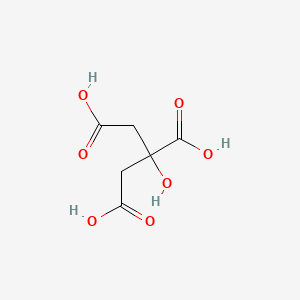
Citric acid is a tricarboxylic acid that is propane-1,2,3-tricarboxylic acid bearing a hydroxy substituent at position 2. It is an important metabolite in the pathway of all aerobic organisms. It has a role as a food acidity regulator, a chelator, an antimicrobial agent, a fundamental metabolite and a calcium chelator. It is a conjugate acid of a citrate(1-) and a citrate anion.
Research Context
Citric acid, a key organic acid found in various fruits, especially citrus, has garnered significant attention in both industrial and laboratory settings due to its versatile properties and applications. This compound plays a crucial role in numerous research applications, particularly in biochemistry and food science. Its ability to act as a natural preservative, flavor enhancer, and chelating agent makes it invaluable in the formulation of various products, including pharmaceuticals and cosmetics.
Mechanism of Action
The mechanism of action of citric acid primarily revolves around its acidity and ability to modulate pH levels in solutions. In biochemical processes, citric acid can participate in the citric acid cycle (Krebs cycle), which is fundamental for energy production in living organisms. Additionally, it can influence enzyme activity and stability, further demonstrating its importance in metabolic research.
Solubility and Storage Advice
Citric acid is highly soluble in water, making it easy to incorporate into various aqueous formulations. When storing citric acid, it is essential to keep it in a cool, dry place, away from direct sunlight and moisture to maintain its stability. It is advisable to use airtight containers to prevent contamination and degradation over time. In its powdered form, it should be handled with care to avoid inhalation or contact with skin, as it can cause irritation.
Future Research Directions
Looking ahead, research on citric acid is poised to expand into several promising areas. One significant direction is its application in sustainable agriculture as an environmentally friendly fertilizer and soil enhancer. Furthermore, investigations into its role in drug delivery systems and its potential as a biocompatible agent in medical applications are gaining traction. Additionally, the exploration of citric acid's antioxidant properties presents novel opportunities for its use in health supplements and functional foods.
Overall, citric acid continues to be a subject of extensive research due to its multifaceted applications, making it a compound of great interest for future scientific endeavors.
Need this compound? Check current availability and pricing.
| CAS Number | 77-92-9 |
|---|---|
| Formula | C6H8O7 |
| Mol. Weight | 192.12 g/mol |
| IUPAC Name | 2-hydroxypropane-1,2,3-tricarboxylic acid |
| Grade | Research Grade |
Technical Support & Logistics
Storage & Handling: Citric Acid is strictly allocated for laboratory research use (RUO). Shipped in anti-static packaging.