Triptorelin (CAS 57773-63-4) – Research Grade Peptide
Research Context
Research Applications
Triptorelin is primarily studied for its role in regulating hormone levels in clinical and preclinical research. This peptide is particularly significant in the fields of oncology, endocrinology, and reproductive health. It is primarily utilized for the treatment of hormone-responsive cancers, such as prostate cancer, and in managing conditions like central precocious puberty. Additionally, research has extended to therapeutic areas including metabolic health and body composition.
Triptorelin is FDA-approved under the trade name GnRH agonist and is commonly used in clinical settings to inhibit gonadotropin release, thus reducing testosterone levels in prostate cancer patients. Other trade names associated with this compound include Decapeptyl and Triptodur.
History & Development
Triptorelin was developed by the pharmaceutical company IPSEN in the early 1980s, specifically designed to be a more potent analogue of gonadotropin-releasing hormone (GnRH). The compound received FDA approval in 2000 for the treatment of advanced prostate cancer. Its design features include modifications in the amino acid sequence that enhance its resistance to enzymatic degradation, resulting in a longer half-life and sustained action compared to natural GnRH.
Mechanism of Action
Triptorelin functions as a synthetic agonist of the GnRH receptor, which is located in the pituitary gland. When administered, it binds to these receptors, leading to an initial surge in luteinizing hormone (LH) and follicle-stimulating hormone (FSH). However, with continuous administration, it induces downregulation of the GnRH receptors, leading to decreased secretion of LH and FSH, and consequently lowers testosterone production from the testes. This mechanism is crucial for its therapeutic effects in hormone-sensitive conditions.
Clinical Data
Published studies suggest that Triptorelin is effective in managing prostate cancer. For instance, research by Schmidt et al. indicated that patients treated with Triptorelin showed a significant decrease in serum testosterone levels, achieving castrate levels in over 90% of participants in Phase 3 trials. Another study led by Falutz et al. demonstrated its efficacy in reducing tumor size and improving patient survival rates in advanced prostate cancer. The results of these studies underscore the compound's role in oncology and its potential benefits in hormone regulation.
How It Compares
When comparing Triptorelin to other related compounds, such as Sermorelin and GHRP-6, several key differences emerge. While Sermorelin is primarily a growth hormone-releasing hormone (GHRH) analogue aimed at stimulating growth hormone release, Triptorelin's action is focused on suppressing gonadal hormone production. GHRP-6 also stimulates growth hormone release but does not have the same inhibitory effects on testosterone. In terms of half-life, Triptorelin has a longer duration of action due to its structural modifications, making it preferable for managing chronic conditions like prostate cancer.
Solubility & Storage
For reconstitution, Triptorelin is typically recommended to be dissolved in bacteriostatic water. The storage conditions vary; lyophilized Triptorelin should be stored at -20°C or lower, while the reconstituted solution is best kept at 2-8°C and used within 30 days to maintain stability and efficacy. It is crucial to protect the peptide from light and avoid multiple freeze-thaw cycles to ensure its integrity.
Future Research Directions
Future research directions for Triptorelin are exploring its potential applications beyond hormone-responsive cancers. Investigators are examining its effects on metabolic health, particularly in obesity and related disorders. Additionally, off-label research interests are emerging, focusing on its possible roles in treating conditions like endometriosis and uterine fibroids due to its hormonal modulation capabilities. As the understanding of this peptide evolves, it may open new avenues for therapeutic interventions in various endocrine disorders.
This peptide is available for wholesale & bulk synthesis. Get our rate sheet.
| CAS Number | 57773-63-4 |
|---|---|
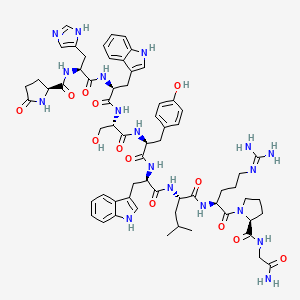
| Formula | C64H82N18O13 |
| Mol. Weight | 1311.4 g/mol |
| IUPAC Name | (2S)-N-[(2S)-1-[[(2S)-1-[[(2S)-1-[[(2S)-1-[[(2R)-1-[[(2S)-1-[[(2S)-1-[(2S)-2-... |
| Grade | HPLC ≥98% |
Synthesis & Storage
Triptorelin is supplied as a lyophilized powder to ensure stability during transit.
For long-term storage of CAS 57773-63-4, we recommend maintaining at -20°C.
Researchers must reconstitute this peptide with bacteriostatic water or sterile solvent only when ready for use.
Quality Control: All batches undergo rigorous HPLC purity testing (≥98%) prior to dispatch from our USA fulfillment center.