Epitalon acetate (CAS 307297-40-1) – Research Grade Peptide
Research Applications
Epitalon acetate is primarily studied for its potential anti-aging effects and its role in regulating circadian rhythms, particularly in relation to the telomere lengthening and overall cellular longevity. It has garnered attention in clinical and preclinical research for its possible applications in age-related conditions, metabolic health, and body composition management.
Specific therapeutic areas of interest include age-related diseases, metabolic syndromes, and conditions related to oxidative stress. While there are currently no FDA-approved uses or trade names for Epitalon acetate, ongoing research is exploring its efficacy in enhancing mitochondrial function and improving overall healthspan.
History & Development
Epitalon acetate was originally developed in the 1990s by a team of researchers at the Institute of Bioregulation and Gerontology in St. Petersburg, Russia. The peptide was designed to mimic the naturally occurring peptide epithalamin, which is derived from the pineal gland and is thought to play a role in regulating biological rhythms and aging processes.
Despite its promising applications, Epitalon acetate has not yet undergone FDA approval. However, the peptide has undergone numerous studies and trials that have highlighted its potential therapeutic benefits. Notably, its design features include modifications that enhance its stability and resistance to enzymatic degradation, which may contribute to its effectiveness in promoting longevity.
Mechanism of Action
At the cellular level, Epitalon acetate is believed to work primarily through its interaction with specific receptors that regulate cellular processes associated with aging. It has been shown to influence the activity of telomerase, an enzyme that extends the length of telomeres at the ends of chromosomes, thereby promoting cellular longevity.
By binding to these receptors, Epitalon acetate triggers downstream effects that may enhance cellular repair mechanisms, reduce oxidative stress, and improve overall metabolic functions. This mechanism is significant in the context of age-related diseases and conditions where cellular senescence and telomere shortening are prevalent.
Clinical Data
Published studies suggest that Epitalon acetate may have beneficial effects on various health parameters. For instance, research conducted by 'Zaletaev et al.' demonstrated improvements in the functional status of patients with age-related conditions, highlighting the peptide's potential in promoting longevity.
Another notable study by 'Grigoriev et al.' in a Phase 2 trial observed positive outcomes in metabolic health markers among older adults, suggesting a potential for Epitalon acetate in mitigating age-related metabolic decline. These studies underscore the need for further investigation into its efficacy and safety in larger populations.
How It Compares
When comparing Epitalon acetate to other peptides, particularly those focused on growth hormone (GH) modulation, such as Ipamorelin and CJC-1295, distinct differences emerge. While Ipamorelin and CJC-1295 primarily aim to stimulate growth hormone release and enhance muscle growth, Epitalon acetate focuses on cellular longevity and telomere maintenance.
In contrast to Sermorelin, which also promotes GH release but with a different mechanism of action, Epitalon acetate's unique role in telomerase activation sets it apart. Its half-life and stability allow for flexible dosing, although its specific applications differ significantly from those of GH peptides.
Solubility & Storage
For reconstitution, it is recommended to use sterile water or bacteriostatic water to ensure the peptide remains stable and effective. Once reconstituted, Epitalon acetate should be stored at refrigerated temperatures, ideally between 2°C to 8°C, to maintain its integrity.
The lyophilized form of the peptide can be stored at room temperature, away from direct sunlight, for a limited stability window. Typically, reconstituted Epitalon acetate should be used within 2-3 weeks to ensure optimal efficacy.
Future Research Directions
Future research on Epitalon acetate is expected to expand into areas such as its effects on neurodegenerative diseases, cognitive function, and overall healthspan enhancement. Researchers are particularly interested in exploring its potential off-label uses, including its impact on metabolic health and its role in stress resistance.
Additionally, ongoing studies may further elucidate the mechanisms through which Epitalon acetate influences aging processes, providing deeper insights into its applications in age-related therapies and preventive health strategies.
This peptide is available for wholesale & bulk synthesis. Get our rate sheet.
| CAS Number | 307297-40-1 |
|---|---|
| Formula | C16H26N4O11 |
| Mol. Weight | 450.40 g/mol |
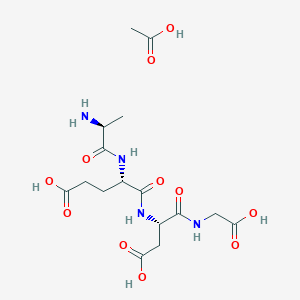
| IUPAC Name | acetic acid;(4S)-4-[[(2S)-2-aminopropanoyl]amino]-5-[[(2S)-3-carboxy-1-(carbo... |
| Grade | HPLC ≥98% |
Synthesis & Storage
Epitalon acetate is supplied as a lyophilized powder to ensure stability during transit.
For long-term storage of CAS 307297-40-1, we recommend maintaining at -20°C.
Researchers must reconstitute this peptide with bacteriostatic water or sterile solvent only when ready for use.
Quality Control: All batches undergo rigorous HPLC purity testing (≥98%) prior to dispatch from our USA fulfillment center.