Eptifibatide (CAS 188627-80-7) – Research Grade Peptide
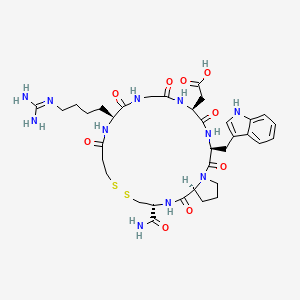
Eptifibatide is a synthetic homodetic cyclic peptide comprising Nalpha-(3-sulfanylpropanoyl)homoarginyl, glycyl, aspartyl, tryptophyl, prolyl and cysteinamide residues connected in sequence and cyclised via a disulfide bond. Derived from a protein found in the venom of the southeastern pygmy rattlesnake, Sistrurus miliarus barbouri, eptifibatide is an anti-coagulant that inhibits platelet aggregation by selectively blocking the platelet glycoprotein IIb/IIIa receptor, so preventing the binding of fibrinogen, von Willebrand factor, and other adhesive ligands. It is used in the management of unstable angina and in patients undergoing coronary angioplasty and stenting procedures. It has a role as an anticoagulant and a platelet aggregation inhibitor. It is a homodetic cyclic peptide, an organic disulfide and a macrocycle.
Research Context
Research Applications
Eptifibatide is primarily studied for its role as an antiplatelet agent in clinical and preclinical research, particularly in the management of acute coronary syndrome (ACS) and during percutaneous coronary interventions (PCI). This peptide is integral to research in cardiovascular health and thrombosis prevention. While Eptifibatide does not have a formal trade name, it is often associated with its parent company, Merck & Co., which has been instrumental in its development.
The therapeutic areas of interest include acute myocardial infarction, unstable angina, and the prevention of thrombotic events in patients undergoing coronary angioplasty. As a peptide derived from the venom of the southeastern pygmy rattlesnake, Eptifibatide exhibits a unique mechanism that is being explored for potential applications beyond traditional cardiovascular uses.
History & Development
Eptifibatide was originally developed by researchers at the pharmaceutical company Merck & Co. in the late 1990s. It received FDA approval in 1998 for use in patients with acute coronary syndrome and is used in conjunction with aspirin and heparin. The drug is marketed under the trade name Integrilin.
Key regulatory milestones include its approval for use during PCI procedures, allowing for a significant reduction in the risk of thrombotic complications. Notable design features of Eptifibatide include its high affinity for the glycoprotein IIb/IIIa receptor on platelets, which helps inhibit platelet aggregation effectively.
Mechanism of Action
Eptifibatide operates by selectively binding to the glycoprotein IIb/IIIa receptor on activated platelets. This action prevents fibrinogen from binding to the receptor, thereby inhibiting platelet aggregation and thrombus formation. The downstream effects of this mechanism lead to a reduction in the incidence of thrombotic events in patients experiencing acute coronary syndromes.
By blocking this critical pathway in platelet activation, Eptifibatide effectively reduces the risk of myocardial infarction and other ischemic complications in high-risk cardiovascular patients.
Clinical Data
Clinical data supporting the efficacy of Eptifibatide comes from several studies, including a pivotal trial led by the author 'Kastrati et al.' which demonstrated the peptide's effectiveness in reducing major adverse cardiac events during PCI procedures. Published studies suggest that Eptifibatide can lead to significant improvements in patient outcomes, with reductions in the incidence of myocardial infarction and the need for urgent revascularization.
Additionally, a Phase 3 study published in the 'Journal of the American College of Cardiology' highlighted that Eptifibatide treatment resulted in a 20% reduction in the composite endpoint of death, myocardial infarction, or urgent revascularization when compared to placebo.
How It Compares
When comparing Eptifibatide to other antiplatelet agents, such as Abciximab and Tirofiban, notable differences emerge in their mechanisms and applications. Abciximab, a monoclonal antibody, also targets the glycoprotein IIb/IIIa receptor but has a longer half-life and is typically administered as a bolus followed by an infusion. Tirofiban, similar to Eptifibatide, is a non-peptide small molecule inhibitor but has a shorter duration of action.
In terms of research applications, Eptifibatide is often evaluated alongside these agents in clinical trials focusing on ACS and PCI, providing insights into their relative efficacy and safety profiles.
Solubility & Storage
The recommended reconstitution solvent for Eptifibatide is sterile water or saline, allowing for proper solubilization of the peptide. For optimal storage, lyophilized Eptifibatide should be kept at -20°C, while the reconstituted solution is typically stable for 24 hours when stored at 2-8°C. After reconstitution, it is advisable to use Eptifibatide promptly to ensure maximum efficacy.
Future Research Directions
Future research directions for Eptifibatide focus on exploring its potential applications in other areas of cardiovascular health, including chronic heart failure and peripheral artery disease. Researchers are also investigating off-label interests in the management of thrombosis in non-cardiac surgical settings, as well as its use in combination therapies with newer antiplatelet agents.
Emerging studies aim to better understand the long-term effects and safety profile of Eptifibatide in diverse patient populations, potentially broadening its therapeutic scope beyond acute coronary syndromes.
This peptide is available for wholesale & bulk synthesis. Get our rate sheet.
| CAS Number | 188627-80-7 |
|---|---|
| Formula | C35H49N11O9S2 |
| Mol. Weight | 832.0 g/mol |
| IUPAC Name | 2-[(3S,6S,12S,20R,23S)-20-carbamoyl-12-[4-(diaminomethylideneamino)butyl]-3-(... |
| Grade | HPLC ≥98% |
Synthesis & Storage
Eptifibatide is supplied as a lyophilized powder to ensure stability during transit.
For long-term storage of CAS 188627-80-7, we recommend maintaining at -20°C.
Researchers must reconstitute this peptide with bacteriostatic water or sterile solvent only when ready for use.
Quality Control: All batches undergo rigorous HPLC purity testing (≥98%) prior to dispatch from our USA fulfillment center.