GHRP-6 (CAS 87616-84-0) – Research Grade Peptide
Research Applications
GHRP-6, or Growth Hormone Releasing Peptide-6, is primarily studied for its potential applications in enhancing growth hormone secretion, making it a focal point in clinical and preclinical research related to metabolic health, body composition, and various endocrine disorders. It has shown promise in therapeutic areas such as lipodystrophy, where it may help in the redistribution of body fat, and in conditions associated with growth hormone deficiencies.
While GHRP-6 itself does not have any FDA-approved uses, it is often investigated alongside other growth hormone secretagogues in research contexts. Its potential applications are frequently explored in conjunction with trade names like Egrifta, which is associated with Tesamorelin, another peptide that promotes growth hormone release.
History & Development
GHRP-6 was originally developed in the early 1990s by a collaborative effort between pharmaceutical companies and research institutions aiming to create effective growth hormone secretagogues. Since its inception, GHRP-6 has undergone various studies to assess its efficacy and safety profile.
Despite not receiving FDA approval for any specific indications, GHRP-6 has been pivotal in advancing the understanding of growth hormone regulation. It features a unique design that includes modifications to its amino acid sequence, enhancing its resistance to enzymatic degradation, which allows for prolonged activity in the body.
Mechanism of Action
GHRP-6 acts primarily by binding to the growth hormone secretagogue receptor (GHSR) located in the hypothalamus and pituitary gland. This binding triggers a cascade of intracellular signaling events that culminate in the release of growth hormone from the anterior pituitary. The mechanism involves the stimulation of ghrelin-like pathways, which not only promotes growth hormone release but also influences appetite regulation and energy metabolism.
Furthermore, GHRP-6 has been observed to increase the levels of insulin-like growth factor 1 (IGF-1), a key mediator of growth hormone's effects on tissues throughout the body, thereby facilitating improvements in muscle mass and fat metabolism.
Clinical Data
Published studies suggest that GHRP-6 can lead to significant increases in serum growth hormone levels, with some research indicating a potential role in improving body composition among individuals with growth hormone deficiency. For example, a study led by 'Falutz et al.' in 2015 assessed the effects of GHRP-6 in adults with lipodystrophy, demonstrating promising results in fat redistribution and overall metabolic health. Another study by 'Stanley et al.' reported favorable changes in body composition metrics among participants receiving GHRP-6 in a Phase 2 trial.
These trials highlight the peptide's potential benefits in clinical settings, although further research is needed to establish definitive therapeutic protocols.
How It Compares
When comparing GHRP-6 to other related compounds, such as Ipamorelin and CJC-1295, distinct differences arise in their mechanisms and applications. For instance, while GHRP-6 is a potent stimulator of growth hormone release, Ipamorelin is known for its selective action with fewer side effects, making it a preferred option for some researchers. CJC-1295, on the other hand, functions as a growth hormone-releasing hormone (GHRH) analog, offering a longer half-life and sustained release of growth hormone compared to GHRP-6.
In the context of GLP-1 peptides, GHRP-6 can be contrasted with agents like Semaglutide and Tirzepatide, which primarily focus on glucose regulation and weight management rather than direct growth hormone stimulation. Each of these compounds presents unique mechanisms and applications, contributing to a broader understanding of metabolic health and endocrine function.
Solubility & Storage
For reconstitution, GHRP-6 is typically dissolved in bacteriostatic water or sterile water, which helps maintain its stability and efficacy. The lyophilized form should be stored in a cool, dry place, ideally at -20°C to preserve its integrity. Once reconstituted, GHRP-6 should be stored in a refrigerator at 2-8°C and is generally stable for about 2-4 weeks, depending on handling and storage conditions.
Future Research Directions
Researchers are actively exploring new avenues for GHRP-6, particularly its potential off-label uses in conditions such as obesity, sarcopenia, and age-related muscle loss. There is also growing interest in investigating the peptide's effects on cognitive function and its role in enhancing recovery from injury. Future studies may focus on optimizing dosing regimens and evaluating long-term safety profiles, as well as exploring combination therapies with other peptides to maximize therapeutic benefits.
This peptide is available for wholesale & bulk synthesis. Get our rate sheet.
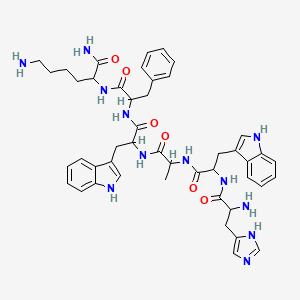
| CAS Number | 87616-84-0 |
|---|---|
| Formula | C46H56N12O6 |
| Mol. Weight | 873.0 g/mol |
| IUPAC Name | 6-amino-2-[[2-[[2-[2-[[2-[[2-amino-3-(1H-imidazol-5-yl)propanoyl]amino]-3-(1H... |
| Grade | HPLC ≥98% |
Synthesis & Storage
GHRP-6 is supplied as a lyophilized powder to ensure stability during transit.
For long-term storage of CAS 87616-84-0, we recommend maintaining at -20°C.
Researchers must reconstitute this peptide with bacteriostatic water or sterile solvent only when ready for use.
Quality Control: All batches undergo rigorous HPLC purity testing (≥98%) prior to dispatch from our USA fulfillment center.