Gonadorelin (CAS 33515-09-2) – Research Grade Peptide
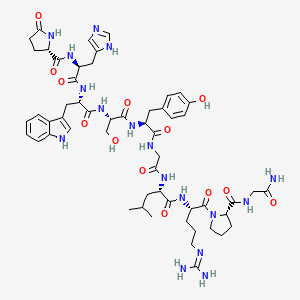
Gonadorelin is a ten-membered synthetic oligopeptide comprising pyroglutamyl, histidyl, tryptophyl, seryl, tyrosyl, glycyl, leucyl, arginyl, prolyl and glycinamide residues joined in sequence. It has a role as a gonadotropin releasing hormone agonist. It is an oligopeptide and a peptide hormone.
Research Context
Research Applications
Gonadorelin is primarily studied for its role in reproductive health, particularly in the treatment of conditions related to hypothalamic hypogonadism and fertility. Research applications include its use in evaluating and treating disorders such as delayed puberty, hypogonadism, and infertility. Gonadorelin is notably involved in the therapeutic area of reproductive endocrinology.
While it does not have a widely recognized FDA-approved trade name like some other peptides, it is often utilized in clinical settings to stimulate gonadotropin release, thus facilitating reproductive processes. Its primary function in clinical and preclinical research is to act as a gonadotropin-releasing hormone (GnRH) analog, which is crucial for initiating the hormonal cascade that leads to the production of sex hormones.
History & Development
Gonadorelin was first synthesized in the early 1970s by a team led by Dr. Andrew V. Schally, a notable figure in the field of endocrinology. His work laid the foundation for the development of various GnRH analogs, including Gonadorelin itself. The peptide gained attention for its potential therapeutic applications in reproductive health.
Regulatory milestones for Gonadorelin include its approval by the FDA for use in diagnostic testing of hypothalamic function. Although it is not marketed under a specific trade name, it has been utilized in various clinical studies and applications since its introduction. Noteworthy design features of Gonadorelin include its stability and efficacy in mimicking the natural GnRH, facilitating the release of luteinizing hormone (LH) and follicle-stimulating hormone (FSH) from the anterior pituitary.
Mechanism of Action
Gonadorelin functions by binding to the GnRH receptors located on the pituitary gland. This binding initiates a signaling cascade that results in the secretion of gonadotropins, specifically LH and FSH. These hormones are critical for the regulation of the reproductive system, influencing processes such as ovulation and spermatogenesis.
The downstream effects of Gonadorelin include the stimulation of gonadal steroidogenesis, which leads to increased production of estrogen and testosterone. This mechanism underscores its importance in both therapeutic and research settings, particularly in understanding reproductive endocrinology and hormonal regulation.
Clinical Data
Published studies suggest that Gonadorelin is effective in various clinical applications. For instance, a study by 'Sinha et al.' published in the Journal of Clinical Endocrinology & Metabolism demonstrated the efficacy of Gonadorelin in increasing serum LH and FSH levels in patients with hypogonadotropic hypogonadism. Another notable study by 'Kelley et al.' in the journal Fertility and Sterility indicated that Gonadorelin administration could lead to significant improvements in reproductive hormone profiles in men with fertility issues.
These studies highlight the peptide's potential in both diagnostic and therapeutic contexts, emphasizing its role in restoring hormonal balance and fertility.
How It Compares
When comparing Gonadorelin to other peptides in the field, such as Ipamorelin and CJC-1295, several differences emerge. Gonadorelin primarily stimulates the release of gonadotropins, whereas Ipamorelin and CJC-1295 are more focused on growth hormone release. Ipamorelin, for instance, is known for its selective action on growth hormone secretagogues and has a longer half-life, making it preferable for certain applications.
Additionally, Gonadorelin’s mechanism is distinct from that of GLP-1 peptides such as Semaglutide or Liraglutide, which are primarily involved in glucose metabolism and weight management. While Semaglutide focuses on insulin regulation and appetite suppression, Gonadorelin's role centers around reproductive hormone regulation.
Solubility & Storage
For reconstitution, Gonadorelin is typically dissolved in sterile water or bacteriostatic water, which helps maintain its stability and efficacy. Storage recommendations indicate that the lyophilized form of Gonadorelin should be kept in a cool, dry place, ideally at -20°C. Once reconstituted, the peptide should be stored in a refrigerator at 2-8°C and is generally stable for about 30 days, although this can vary based on specific conditions.
Future Research Directions
Future research directions for Gonadorelin are focusing on its potential applications beyond traditional reproductive health. Researchers are exploring its off-label use in conditions such as polycystic ovary syndrome (PCOS) and its role in gender-affirming treatments for transgender individuals. Additionally, investigations into its effects on metabolic health and body composition are emerging, suggesting a broader scope of therapeutic potential.
As the understanding of GnRH analogs continues to evolve, Gonadorelin may find new applications in both clinical and research settings, paving the way for innovative therapies in reproductive and metabolic health.
This peptide is available for wholesale & bulk synthesis. Get our rate sheet.
| CAS Number | 33515-09-2 |
|---|---|
| Formula | C55H75N17O13 |
| Mol. Weight | 1182.3 g/mol |
| IUPAC Name | (2S)-N-[(2S)-1-[[(2S)-1-[[(2S)-1-[[(2S)-1-[[2-[[(2S)-1-[[(2S)-1-[(2S)-2-[(2-a... |
| Grade | HPLC ≥98% |
Synthesis & Storage
Gonadorelin is supplied as a lyophilized powder to ensure stability during transit.
For long-term storage of CAS 33515-09-2, we recommend maintaining at -20°C.
Researchers must reconstitute this peptide with bacteriostatic water or sterile solvent only when ready for use.
Quality Control: All batches undergo rigorous HPLC purity testing (≥98%) prior to dispatch from our USA fulfillment center.