Leuprolide (CAS 53714-56-0) – Research Grade Peptide
Research Context
Research Applications
Leuprolide is primarily studied for its role in the treatment of hormone-sensitive conditions, particularly in the fields of oncology and reproductive health. It is commonly utilized in the management of prostate cancer, endometriosis, and precocious puberty. In clinical and preclinical research, Leuprolide has shown promise in therapeutic areas such as metabolic health and body composition, particularly due to its effects on hormone modulation.
Leuprolide is FDA-approved under the trade name Lupron, primarily for the treatment of advanced prostate cancer, endometriosis, and uterine fibroids. Its ability to suppress estrogen and testosterone production makes it a valuable tool in these therapeutic areas.
History & Development
Leuprolide was originally developed by the pharmaceutical company TAP Pharmaceuticals in the early 1980s. The compound received FDA approval in 1985 for the treatment of advanced prostate cancer under the trade name Lupron. Since then, it has been prescribed for various other indications, including endometriosis and precocious puberty.
One notable design feature of Leuprolide is its structural modification as a gonadotropin-releasing hormone (GnRH) analog, which confers resistance to enzymatic degradation. This modification allows for a sustained action within the body, enhancing its therapeutic efficacy.
Mechanism of Action
Leuprolide functions as a potent agonist of the GnRH receptor, leading to an initial surge in the secretion of luteinizing hormone (LH) and follicle-stimulating hormone (FSH). However, with continuous administration, it induces downregulation of GnRH receptors, resulting in decreased production of sex hormones such as estrogen and testosterone. This mechanism is particularly beneficial in treating hormone-sensitive tumors and conditions.
By binding to GnRH receptors in the pituitary gland, Leuprolide effectively alters the hormonal milieu, leading to reduced levels of circulating sex hormones, which is crucial in managing conditions like prostate cancer and endometriosis.
Clinical Data
Published studies suggest that Leuprolide is effective in reducing symptoms associated with hormone-driven conditions. For instance, research led by Falutz et al. demonstrated that patients undergoing Leuprolide treatment experienced significant improvements in their condition, with many reporting a marked reduction in pain associated with endometriosis. This study was part of a Phase 3 trial published in the journal Obstetrics & Gynecology.
Another notable study by Stanley et al. indicated that Leuprolide administration can lead to a substantial decrease in tumor size in patients with advanced prostate cancer, showcasing its clinical utility in oncology. These findings highlight the compound's effectiveness and safety profile in managing hormone-related disorders.
How It Compares
When comparing Leuprolide to other related compounds, it is essential to consider their mechanisms, half-lives, and research applications. For example, Ipamorelin and CJC-1295 are both growth hormone secretagogues that function differently than Leuprolide, which primarily modulates GnRH pathways. While Leuprolide is used to suppress sex hormone production, Ipamorelin and CJC-1295 are often evaluated for their potential in promoting muscle growth and fat loss.
In the realm of GLP-1 peptides, compounds such as Semaglutide and Liraglutide are explored for their effects on glucose metabolism and weight management. These peptides operate through different pathways compared to Leuprolide, which specifically targets the GnRH receptor. The distinctions in their mechanisms and applications underscore the diverse therapeutic potentials of these peptides.
Solubility & Storage
Leuprolide is typically reconstituted using bacteriostatic water or sterile water. For optimal stability, the lyophilized form should be stored at a temperature between 2-8°C. Once reconstituted, it is advisable to keep the solution refrigerated and use it within 28 days to ensure efficacy and safety.
Future Research Directions
Future research is exploring the potential of Leuprolide beyond its current FDA-approved indications. Areas of interest include its off-label use in managing conditions such as polycystic ovary syndrome (PCOS) and its role in hormone therapy for transgender individuals. Additionally, studies are investigating the long-term effects of Leuprolide on metabolic health and body composition in various patient populations, aiming to uncover new therapeutic applications.
This peptide is available for wholesale & bulk synthesis. Get our rate sheet.
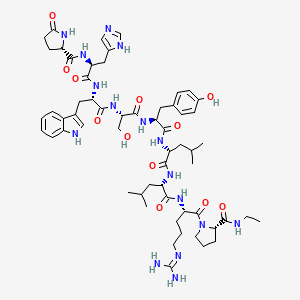
| CAS Number | 53714-56-0 |
|---|---|
| Formula | C59H84N16O12 |
| Mol. Weight | 1209.4 g/mol |
| IUPAC Name | (2S)-N-[(2S)-1-[[(2S)-1-[[(2S)-1-[[(2S)-1-[[(2R)-1-[[(2S)-1-[[(2S)-5-(diamino... |
| Grade | HPLC ≥98% |
Synthesis & Storage
Leuprolide is supplied as a lyophilized powder to ensure stability during transit.
For long-term storage of CAS 53714-56-0, we recommend maintaining at -20°C.
Researchers must reconstitute this peptide with bacteriostatic water or sterile solvent only when ready for use.
Quality Control: All batches undergo rigorous HPLC purity testing (≥98%) prior to dispatch from our USA fulfillment center.