Liraglutide (CAS 204656-20-2) – Research Grade Peptide
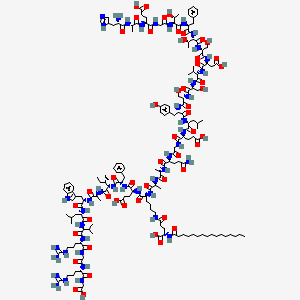
Liraglutide is a lipopeptide that is an analogue of human GLP-1 in which the lysine residue at position 27 is replaced by arginine and a hexadecanoyl group attached to the remaining lysine via a glutamic acid spacer. Used as an adjunct to diet and exercise to improve glycemic control in adults with type 2 diabetes mellitus. It has a role as a neuroprotective agent and a glucagon-like peptide-1 receptor agonist. It is a polypeptide and a lipopeptide.
Research Context
Research Applications
Liraglutide is primarily studied for its role in managing type 2 diabetes and obesity. It is a glucagon-like peptide-1 (GLP-1) analog that enhances insulin secretion and promotes weight loss, making it a vital compound in metabolic health research. Therapeutic areas of interest include diabetes management, weight reduction, and potential applications in cardiovascular health and lipodystrophy. Liraglutide is FDA-approved under the trade names Saxenda for weight management and Victoza for glycemic control in type 2 diabetes.
History & Development
Liraglutide was developed by the Danish pharmaceutical company Novo Nordisk and was first introduced in 2010. The compound gained FDA approval in 2010 for the treatment of type 2 diabetes and was subsequently approved in 2014 for chronic weight management. Notable design features of Liraglutide include modifications that confer resistance to enzymatic degradation, allowing for a prolonged half-life compared to endogenous GLP-1. The amino acid sequence has been altered to enhance stability and efficacy, which contributes to its therapeutic benefits.
Mechanism of Action
Liraglutide functions by mimicking the action of endogenous GLP-1, a hormone that plays a critical role in glucose metabolism. It binds to the GLP-1 receptor, which is predominantly expressed in pancreatic beta cells, the central nervous system, and the gastrointestinal tract. Upon binding, Liraglutide stimulates insulin secretion in a glucose-dependent manner, suppresses glucagon release, and slows gastric emptying. These actions collectively contribute to improved glycemic control and promote satiety, leading to weight loss.
Clinical Data
Published studies suggest significant efficacy of Liraglutide in managing type 2 diabetes and obesity. For instance, the LEAD (Liraglutide Effect and Action in Diabetes) trials, led by authors such as 'Nissen et al.', demonstrated that Liraglutide administration resulted in a notable reduction in HbA1c levels and weight loss in patients with type 2 diabetes. In particular, Phase 3 trials indicated that patients treated with Liraglutide experienced an average weight loss of around 5-10% compared to placebo. Another study, 'Astrup et al.', highlighted the safety and efficacy of Liraglutide for weight management, showing that participants achieved significant weight reduction along with improvements in metabolic parameters.
How It Compares
When comparing Liraglutide to other GLP-1 receptor agonists such as Semaglutide and Tirzepatide, several differences in mechanisms, half-lives, and research applications emerge. Semaglutide, for example, has a longer half-life than Liraglutide, allowing for once-weekly dosing versus Liraglutide's daily administration. Tirzepatide, a dual GLP-1 and GIP receptor agonist, has shown promising results in recent studies, suggesting enhanced efficacy in weight loss and glycemic control. While all three compounds target GLP-1 receptors, their unique properties and dosing regimens cater to different patient needs and treatment strategies.
Solubility & Storage
Liraglutide is typically reconstituted using bacteriostatic water or sterile water. For optimal storage, the lyophilized form of Liraglutide should be kept in a refrigerator at temperatures between 2-8°C. Once reconstituted, it is recommended to store the solution in a refrigerator as well, and it should be used within 30 days for best results. Careful adherence to these storage guidelines ensures the stability and efficacy of the compound.
Future Research Directions
Future research directions for Liraglutide are focusing on its potential off-label uses, including cardiovascular protection and its role in preventing diabetes-related complications. Researchers are also exploring its applications in non-diabetic populations for weight management and metabolic health. Emerging studies are investigating the synergistic effects of Liraglutide when combined with other therapeutic agents, as well as its impact on gut microbiota and overall metabolic profiles.
This peptide is available for wholesale & bulk synthesis. Get our rate sheet.
| CAS Number | 204656-20-2 |
|---|---|
| Formula | C172H265N43O51 |
| Mol. Weight | 3751 g/mol |
| IUPAC Name | (2S)-5-[[(5S)-5-[[(2S)-2-[[(2S)-2-[[(2S)-5-amino-2-[[2-[[(2S)-2-[[(2S)-2-[[(2... |
| Grade | HPLC ≥98% |
Synthesis & Storage
Liraglutide is supplied as a lyophilized powder to ensure stability during transit.
For long-term storage of CAS 204656-20-2, we recommend maintaining at -20°C.
Researchers must reconstitute this peptide with bacteriostatic water or sterile solvent only when ready for use.
Quality Control: All batches undergo rigorous HPLC purity testing (≥98%) prior to dispatch from our USA fulfillment center.