Methylene Blue (CAS 61-73-4) – Research Grade
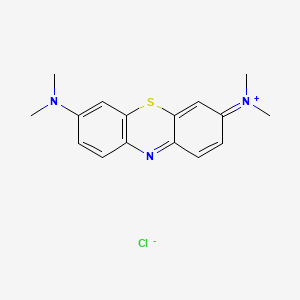
Methylene blue is an organic chloride salt having 3,7-bis(dimethylamino)phenothiazin-5-ium as the counterion. A commonly used dye that also exhibits antioxidant, antimalarial, antidepressant and cardioprotective properties. It has a role as an EC 1.4.3.4 (monoamine oxidase) inhibitor, an acid-base indicator, a fluorochrome, an antidepressant, a cardioprotective agent, an EC 3.1.1.8 (cholinesterase) inhibitor, a histological dye, an EC 4.6.1.2 (guanylate cyclase) inhibitor, an antioxidant, an antimicrobial agent, a neuroprotective agent, a physical tracer and an antimalarial. It contains a 3,7-bis(dimethylamino)phenothiazin-5-ium.
Research Context
Methylene Blue, a well-known synthetic dye, has garnered significant attention in various fields of research due to its versatile applications. Commonly utilized in biology and medicine, this compound is often employed as a stain for microscopy and as a redox indicator in analytical chemistry. Additionally, its use extends to the treatment of methemoglobinemia, where it serves as a reducing agent to restore the normal function of hemoglobin in the blood.
Mechanism of Action
The mechanism of action of Methylene Blue is multifaceted. It functions primarily as an electron donor, facilitating the reduction of methemoglobin back to hemoglobin. Furthermore, it exhibits antimicrobial properties, which are attributed to its ability to generate reactive oxygen species under specific conditions, contributing to its efficacy in treating various infections. In recent studies, Methylene Blue has also shown promise in neuroprotection, particularly in conditions like Alzheimer's disease, potentially mitigating oxidative stress and improving mitochondrial function.
Solubility and Storage Advice
Methylene Blue is soluble in water, making it easily applicable in aqueous environments. However, proper storage is crucial to maintain its efficacy. It should be stored in a cool, dry place, away from light, to prevent degradation. Containers should be tightly sealed to avoid moisture ingress, which can compromise the compound's stability.
Future Research Directions
Future research on Methylene Blue is poised to explore its therapeutic potential beyond traditional applications. Current investigations are examining its role in treating neurodegenerative diseases, its effectiveness as a photosensitizer in photodynamic therapy, and its impact on cellular signaling pathways. Additionally, researchers are looking into the optimization of dosing protocols and exploring novel formulations to enhance bioavailability. As ongoing studies continue to unveil its multifaceted roles, Methylene Blue remains a compound of great interest in both academic and clinical settings.
Need this compound? Check current availability and pricing.
| CAS Number | 61-73-4 |
|---|---|
| Formula | C16H18ClN3S |
| Mol. Weight | 319.9 g/mol |
| IUPAC Name | [7-(dimethylamino)phenothiazin-3-ylidene]-dimethylazanium chloride |
| Grade | Research Grade |
Technical Support & Logistics
Storage & Handling: Methylene Blue is strictly allocated for laboratory research use (RUO). Shipped in anti-static packaging.