NAD+ (CAS 53-84-9) – Research Grade Peptide
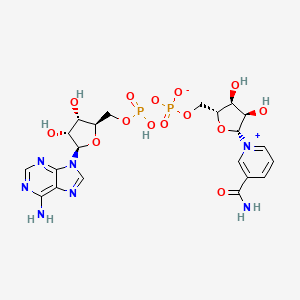
NAD zwitterion is a NAD. It has a role as a geroprotector. It is functionally related to a deamido-NAD zwitterion. It is a conjugate base of a NAD(+).
Research Context
Research Applications
NAD+ (Nicotinamide adenine dinucleotide) is primarily studied in clinical and preclinical research for its critical role in cellular metabolism and energy production. It has gained attention for its potential therapeutic applications in various areas, including metabolic health, age-related diseases, and neurodegenerative disorders. Notably, NAD+ is being explored in the context of conditions such as lipodystrophy, obesity, and diabetes. While there are currently no FDA-approved drugs specifically for NAD+, its precursors, such as nicotinamide riboside (NR) and nicotinamide mononucleotide (NMN), have gained traction in research and consumer markets.
History & Development
NAD+ was first discovered in the early 20th century, with significant contributions from researchers like Arthur Harden and William John Young. The compound has since been extensively studied for its biochemical roles. While there is no single company responsible for its development, various academic institutions and biotech companies have investigated its potential therapeutic applications over the years. Regulatory milestones related to NAD+ are primarily associated with its precursors, such as nicotinamide riboside, which received attention for its potential health benefits. The ongoing research continues to examine the compound's role in enhancing cellular function and longevity.
Mechanism of Action
NAD+ functions as a crucial coenzyme in redox reactions, facilitating the transfer of electrons in metabolic pathways. It plays a vital role in energy production within the mitochondria by participating in the electron transport chain. Additionally, NAD+ serves as a substrate for several key enzymes, including sirtuins and poly(ADP-ribose) polymerases (PARPs), which are involved in cellular stress responses and DNA repair. Through these interactions, NAD+ influences various signaling pathways that promote cellular health and longevity. The restoration of NAD+ levels in cells has been shown to enhance mitochondrial function and improve metabolic profiles.
Clinical Data
Published studies suggest that NAD+ and its precursors may have significant benefits in metabolic health. For instance, a study led by 'Mills et al.' in 2016 demonstrated that supplementation with nicotinamide riboside resulted in increased NAD+ levels and improved insulin sensitivity in prediabetic men, highlighting its potential in metabolic disorders. Another study by 'Zhang et al.' in 2019 explored the effects of NAD+ on mitochondrial function and found that it could enhance energy metabolism and reduce oxidative stress in aging models. These studies indicate promising avenues for further research, particularly in Phase 2 trials focusing on metabolic health and age-related conditions.
How It Compares
NAD+ is often compared to related compounds such as nicotinamide riboside (NR) and nicotinamide mononucleotide (NMN), both of which act as precursors to NAD+. While NAD+ itself is vital for cellular metabolism, NR and NMN are being investigated for their potential to elevate NAD+ levels in the body. The mechanisms differ slightly; NR and NMN are thought to be more readily absorbed and converted into NAD+ in cells. In terms of half-life, NAD+ has a relatively short duration of action in vivo, while its precursors may offer more sustained effects. Research applications for NR and NMN often align with those for NAD+, focusing on metabolic health and aging.
Solubility & Storage
For reconstitution, NAD+ is typically dissolved in sterile water or a suitable buffer solution. The recommended storage temperature for lyophilized NAD+ is at -20°C, while the reconstituted form should be stored at 4°C to maintain stability. After reconstitution, NAD+ is generally stable for a limited period, typically several days to a week, depending on the storage conditions and absence of light exposure.
Future Research Directions
Future research on NAD+ is exploring its potential applications in age-related diseases, neurodegenerative conditions, and metabolic syndromes. Researchers are particularly interested in its role in enhancing mitochondrial function and its implications in diseases like Alzheimer’s and Parkinson’s. Additionally, emerging off-label research is investigating NAD+ as a potential adjunct therapy for cancer treatment, given its involvement in cellular metabolism and energy homeostasis. Ongoing clinical trials will likely provide further insights into the therapeutic potential of NAD+ and its precursors in various health contexts.
This peptide is available for wholesale & bulk synthesis. Get our rate sheet.
| CAS Number | 53-84-9 |
|---|---|
| Formula | C21H27N7O14P2 |
| Mol. Weight | 663.4 g/mol |
| IUPAC Name | [[(2R,3S,4R,5R)-5-(6-aminopurin-9-yl)-3,4-dihydroxyoxolan-2-yl]methoxy-hydrox... |
| Grade | HPLC ≥98% |
Synthesis & Storage
NAD+ is supplied as a lyophilized powder to ensure stability during transit.
For long-term storage of CAS 53-84-9, we recommend maintaining at -20°C.
Researchers must reconstitute this peptide with bacteriostatic water or sterile solvent only when ready for use.
Quality Control: All batches undergo rigorous HPLC purity testing (≥98%) prior to dispatch from our USA fulfillment center.