Noopept (CAS 157115-85-0) – Research Grade Peptide
Research Applications
Noopept, a peptide derived from the racetam family, is primarily studied for its cognitive-enhancing properties. Researchers focus on its potential applications in neuroprotection, memory enhancement, and the management of cognitive decline associated with aging and neurodegenerative diseases. Therapeutic areas of interest include Alzheimer's disease, dementia, and other cognitive disorders.
While Noopept is not FDA-approved for any specific medical use, it has garnered attention for its nootropic effects and is often compared to other cognitive enhancers in research settings. Its popularity in the supplement market has also led to investigations into its efficacy and safety profiles.
History & Development
Noopept was developed in the late 1990s by a team of Russian scientists at the Institute of Molecular Genetics. The compound was synthesized to create a more potent derivative of the racetam class of nootropics, with an emphasis on cognitive enhancement and neuroprotection. Although it has not received FDA approval, it is widely recognized in various countries for its nootropic effects.
Notable design features of Noopept include its ability to cross the blood-brain barrier and its resistance to enzymatic degradation, which contributes to its effectiveness in small doses. This makes it distinct from other peptides that may require higher doses for similar effects.
Mechanism of Action
Noopept exerts its effects primarily through modulation of the glutamatergic system, particularly by enhancing the activity of the AMPA and NMDA receptors. This leads to increased synaptic plasticity, which is crucial for learning and memory. Additionally, Noopept is believed to stimulate the production of brain-derived neurotrophic factor (BDNF), a key protein involved in neuronal growth and survival.
Furthermore, the compound exhibits neuroprotective properties by reducing oxidative stress and inflammation in the brain, which can contribute to cognitive decline. These mechanisms together support Noopept's role as a potential therapeutic agent for cognitive enhancement and neuroprotection.
Clinical Data
Several published studies have investigated the effects of Noopept on cognitive function. One notable study by 'Vlasov et al.' in the journal 'Neuroscience and Behavioral Physiology' reported improvements in memory and learning capabilities among participants after administration of Noopept over a period of weeks. Another study by 'Kovalchuk et al.' demonstrated that Noopept could enhance cognitive performance in conditions of stress and fatigue, suggesting its potential utility in managing cognitive impairment.
Although specific numerical results vary, published studies suggest that participants experienced significant improvements in cognitive function and memory recall. Most studies are in early clinical phases, focusing on safety and efficacy in specific populations.
How It Compares
Noopept is often evaluated alongside other cognitive enhancers and nootropics, such as Piracetam and Aniracetam. While Piracetam serves as a foundational compound in the racetam family, Noopept is considered more potent, requiring smaller doses for similar cognitive effects. In contrast, Aniracetam is known for its anxiolytic properties in addition to cognitive enhancement, differentiating its applications from those of Noopept.
When compared to other related compounds like Semaglutide or Liraglutide, which are GLP-1 receptor agonists, Noopept operates through a distinct mechanism that focuses on glutamate modulation rather than insulin regulation or appetite suppression. This highlights the varied research applications and mechanisms of action among these compounds.
Solubility & Storage
The recommended reconstitution solvent for Noopept is sterile water or bacteriostatic water, as these solvents ensure stability and maintain the peptide's integrity. For optimal storage, the lyophilized form should be kept in a cool, dry place, ideally at temperatures below 25°C. Once reconstituted, Noopept should be stored in a refrigerator at 2-8°C and is typically stable for 2-4 weeks, depending on the specific storage conditions.
Future Research Directions
Future research on Noopept is focusing on its potential applications in treating cognitive impairments associated with aging and neurodegenerative diseases. Researchers are also exploring its effects in various populations, including those with traumatic brain injuries and stress-related cognitive dysfunctions. Emerging off-label interests include its use in enhancing cognitive performance in healthy individuals, particularly in high-stress environments.
As studies continue to evolve, Noopept's role in neuroprotection and cognitive enhancement may offer new insights into therapeutic strategies for a range of neurological conditions.
This peptide is available for wholesale & bulk synthesis. Get our rate sheet.
| CAS Number | 157115-85-0 |
|---|---|
| Formula | C17H22N2O4 |
| Mol. Weight | 318.4 g/mol |
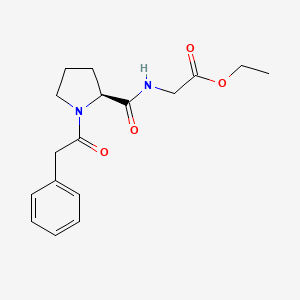
| IUPAC Name | ethyl 2-[[(2S)-1-(2-phenylacetyl)pyrrolidine-2-carbonyl]amino]acetate |
| Grade | HPLC ≥98% |
Synthesis & Storage
Noopept is supplied as a lyophilized powder to ensure stability during transit.
For long-term storage of CAS 157115-85-0, we recommend maintaining at -20°C.
Researchers must reconstitute this peptide with bacteriostatic water or sterile solvent only when ready for use.
Quality Control: All batches undergo rigorous HPLC purity testing (≥98%) prior to dispatch from our USA fulfillment center.