Sulfuric Acid (CAS 7664-93-9) – Research Grade
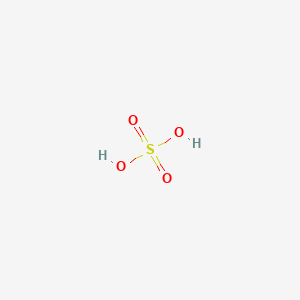
Sulfuric acid is a sulfur oxoacid that consists of two oxo and two hydroxy groups joined covalently to a central sulfur atom. It has a role as a catalyst. It is a conjugate acid of a hydrogensulfate.
Research Context
Sulfuric acid, a highly versatile and strong mineral acid, is extensively utilized in various research applications across numerous scientific fields. Its primary use is in chemical synthesis and industrial processes, where it acts as a dehydrating agent, catalyst, and reagent. In organic chemistry, sulfuric acid facilitates reactions such as esterification and nitration, making it an essential component in the production of explosives, dyes, and pharmaceuticals. Additionally, due to its ability to protonate organic substrates, it plays a vital role in acid-catalyzed reactions.
Mechanism of Action
The mechanism of action of sulfuric acid primarily involves its strong acidic properties, which enable it to donate protons (H+) to various substrates. This protonation can enhance the electrophilicity of reactants, facilitating nucleophilic attacks in chemical reactions. Furthermore, sulfuric acid's dehydrating nature allows it to remove water molecules, driving reactions towards product formation by shifting equilibrium positions. Such properties underscore its importance in both laboratory and industrial settings.
Solubility and Storage Advice
Sulfuric acid is highly soluble in water, and caution is advised when diluting the concentrated form, as the reaction is exothermic and can produce significant heat. It is recommended to always add acid to water rather than the reverse to prevent violent reactions. For storage, sulfuric acid should be kept in tightly sealed glass or polyethylene containers, away from incompatible materials such as organic compounds and bases. It is essential to maintain the storage environment at a controlled temperature to prevent degradation.
Future Research Directions
Future research involving sulfuric acid may focus on its applications in green chemistry, particularly in developing more sustainable processes that minimize environmental impact. Innovations in catalytic processes utilizing sulfuric acid could lead to more efficient synthesis pathways in organic chemistry. Additionally, exploring its role in energy storage technologies, such as in supercapacitors and batteries, may reveal new applications that leverage its unique chemical properties. Continuous investigation into the safety protocols and handling procedures associated with sulfuric acid will also be crucial in promoting safer laboratory practices.
Need this compound? Check current availability and pricing.
| CAS Number | 7664-93-9 |
|---|---|
| Formula | H2O4S |
| Mol. Weight | 98.08 g/mol |
| IUPAC Name | sulfuric acid |
| Grade | Research Grade |
Technical Support & Logistics
Storage & Handling: Sulfuric Acid is strictly allocated for laboratory research use (RUO). Shipped in anti-static packaging.