Urea (CAS 57-13-6) – Research Grade
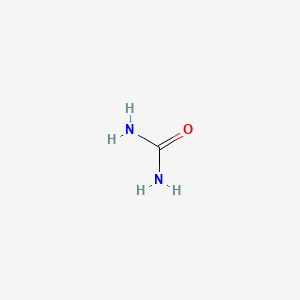
Urea is a carbonyl group with two C-bound amine groups. The commercially available fertilizer has an analysis of 46-0-0 (N-P2O5-K2O). It has a role as a flour treatment agent, a human metabolite, a Daphnia magna metabolite, a Saccharomyces cerevisiae metabolite, an Escherichia coli metabolite, a mouse metabolite and a fertilizer. It is a monocarboxylic acid amide and a one-carbon compound. It is functionally related to a carbonic acid. It is a tautomer of a carbamimidic acid.
Research Context
Urea, also known as carbamide, is a vital compound extensively utilized in various research applications, particularly in agriculture and biochemistry. Its role as a nitrogen source makes it a crucial component in fertilizers, promoting plant growth and enhancing soil fertility. In biochemistry, urea is significant for studies on protein synthesis and metabolism, serving as both a substrate and a product in numerous enzymatic reactions.
Mechanism of Action
The mechanism of action of urea is primarily linked to its role in the urea cycle, a fundamental metabolic pathway that converts ammonia to urea, thereby detoxifying excess nitrogen in organisms. In agricultural applications, urea undergoes hydrolysis, forming ammonium carbonate, which releases nitrogen in a form readily absorbed by plants. This process not only aids in nutrient delivery but also helps in maintaining soil pH levels, creating a conducive environment for plant growth.
Solubility and Storage Advice
Urea is highly soluble in water, making it easy to incorporate into various formulations, including fertilizers and pharmaceuticals. When handling urea, it is advisable to store it in a cool, dry environment, away from strong oxidizing agents to prevent any potential degradation or reaction. Proper storage conditions can prolong the shelf life of urea and maintain its efficacy for research and agricultural purposes.
Future Research Directions
Future research on urea is poised to explore several innovative avenues. One promising direction is the development of slow-release formulations that minimize nitrogen leaching and improve nutrient use efficiency in agriculture. Additionally, investigations into the role of urea in plant signaling and stress responses may unveil new insights into crop resilience. Furthermore, studies on the environmental impact of urea usage and alternative nitrogen sources will be critical in promoting sustainable agricultural practices. Overall, the versatility of urea continues to inspire research across multiple domains, including environmental science and biotechnology.
Need this compound? Check current availability and pricing.
| CAS Number | 57-13-6 |
|---|---|
| Formula | CH4N2O |
| Mol. Weight | 60.056 g/mol |
| IUPAC Name | urea |
| Grade | Research Grade |
Technical Support & Logistics
Storage & Handling: Urea is strictly allocated for laboratory research use (RUO). Shipped in anti-static packaging.